News
Invisible Hidden Hazards, Visible Protection — How Adhesive-Lined Heat Shrink Tubing Protects the "Lifeblood" of Wire Harnesses
The "Invisible Killer" of Wire Harnesses
In the field of wire harness applications, water vapor penetration is the core culprit causing connector failure, degraded insulation performance, and even short circuits and fires. Especially in application scenarios such as outdoor equipment, new energy vehicles, and rail transit, waterproof sealing is no longer a "bonus item", but a "required question" related to system safety. As a professional wire harness manufacturer, we deeply understand that for a high-quality wire harness, from material selection to craftsmanship, every layer of protection directly determines the stability and safety of the entire system operation.
1. Why can't ordinary heat shrink tubing "block" water vapor?
Ordinary single-wall heat shrink tubing only relies on radial shrinkage to tighten the wire sheath, and there are always microscopic gaps between the tube wall and the cable. Affected by changes in environmental temperature difference, water vapor will slowly penetrate through the capillary gaps on the end face through the "breathing effect". Over time, this will cause internal oxidation of the wire harness and decrease of insulation resistance, eventually leading to safety accidents.
Our Solution: Double-Wall Adhesive-Lined Heat Shrink Tubing
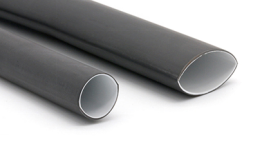
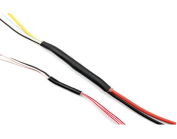
Double-wall adhesive-lined heat shrink tubing adopts a double-layer structure to solve the problem of water vapor penetration from the root:
● Outer layer: Made of cross-linked polyolefin material, it has excellent mechanical wear resistance, and simultaneously meets the requirements of insulation and voltage resistance.
● Inner layer: Made of functional hot-melt adhesive, it melts and flows when heated, fully fills all gaps between the tube wall and the cable, and firmly bonds the wire sheath and the connector.
● After heat shrinkage, a complete "sealing rubber ring" is formed, which ultimately achieves triple protection of moisture-proof, waterproof and anti-corrosion.
2. How to judge whether the adhesive-lined heat shrink tubing is truly sealed?
We have summarized a three-step on-site quick inspection method to help you find hidden dangers in advance:
● Check the ports: There is continuous glue overflow at both ends, and the rubber ring is closely attached to the wire sheath without gaps.
● Observe the tube body: The tube wall is flat and smooth, without bulging or blistering.
● Test insulation: The insulation resistance remains stable in high humidity environments.
3. Our Wire Harness Waterproof Process Standards
In order to ensure the sealing effect of adhesive-lined heat shrink tubing, we have established strict process standards:
● Model selection matching: Select the corresponding adhesive type (normal temperature/high temperature/flame retardant) and shrink ratio according to the wire diameter, working temperature and environmental level to ensure suitability.
● Pretreatment: Clean the connector and keep it dry before processing, thoroughly remove oil stains and oxide layers to ensure that the adhesive layer can be fully bonded.
● Standard heating: Use a heat gun to heat evenly along the ring, control the temperature between 170-200℃ until the adhesive layer overflows from both ends to form a continuous rubber ring.
● Cooling and shaping: Cool naturally to room temperature, forced water cooling is prohibited, to avoid internal stress cracking of the adhesive layer.
● Full inspection system: 100% visual inspection of the glue overflow status, insulation resistance test is carried out one by one for key items, and sampling and cutting are performed to verify the bonding effect.
We welcome your inquiry and visit at any time. Thank you for choosing CYMANU as your global partner!